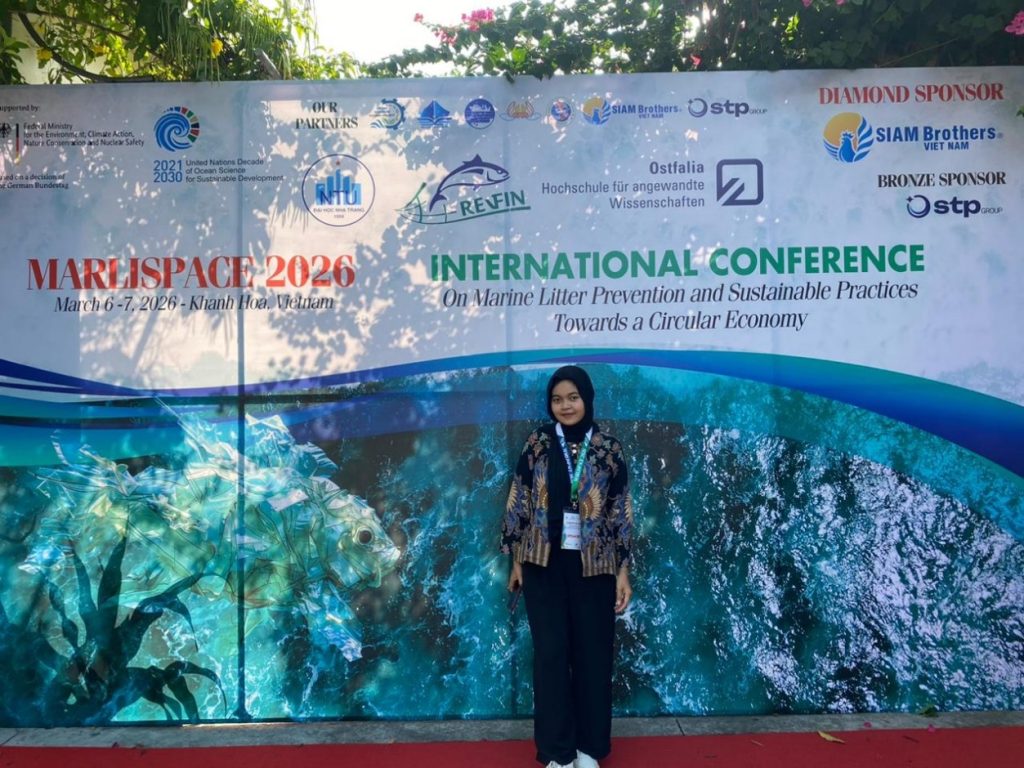
Nur Shafika, Master of Economics Student
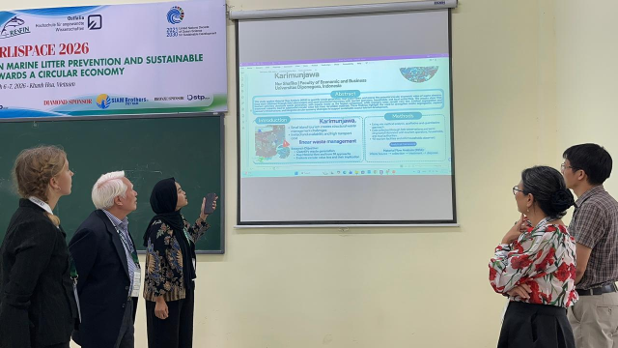
Vietnam, March 2026 – Nur Shafika, a Master’s student in Economics at the Faculty of Economics and Business, Universitas Diponegoro (UNDIP), participated as a speaker at the International Conference on Marine Litter Prevention and Sustainable Practices towards a Circular Economy (MARLISPACE 2026), held from March 6–8, 2026, at Nha Trang University, Vietnam.
At the conference, Nur Shafika presented a paper titled “Balancing Economic and Environmental Performance of Coastal Waste Management: A Circular Economy Assessment in Karimunjawa.” The research addresses strategic issues regarding coastal waste management within a circular economy framework, focusing on the phenomenon of “circular value loss” in the Karimunjawa tourism area. The findings indicate that the rapid growth of marine tourism in Karimunjawa places significant pressure on the coastal waste management system. Across approximately 90 accommodation units, waste generation reaches ±2.5 tons per day (±27.8 kg/unit/day), dominated by plastics (62%) and paper/tissue products (25%). Meanwhile, around 600 households generate ±3 kg of waste daily, the majority of which is still managed through open burning.
From a circular economy perspective, the study reveals that the resource recovery rate remains very low, at approximately 0.2%, with a plastic processing capacity of only ±5 kg per day. This stands in contrast to the potential economic value of recoverable materials, which amounts to approximately IDR 5.75 million per day, whereas the realized value capture is only around IDR 150,000 per day. This results in a circular value loss of ±IDR 5.6 million daily, demonstrating that coastal waste management is still treated as a cost center rather than a source of economic value.
These findings underscore the urgent need to strengthen waste management systems through investment in recovery technologies, the expansion of waste services, and the integration of circular economy approaches into coastal tourism governance. Beyond its impact on economic efficiency, this measure is crucial for mitigating risks such as marine pollution, emissions from open burning, and environmental degradation in archipelagic regions. The MARLISPACE 2026 conference serves as an international scientific forum bringing together academics, researchers, practitioners, and policymakers to address global issues regarding marine debris prevention and sustainable practices aimed at a circular economy. Active participation as a speaker in this forum represents a tangible contribution by UNDIP students to research-based global discourse.
This participation also supports Diponegoro University’s efforts to achieve “World-Class University” status while contributing to the Sustainable Development Goals (SDGs), specifically SDG 12 (Responsible Consumption and Production) and SDG 14 (Life Below Water). As a follow-up, research findings and insights gained during the conference will be disseminated through scientific publications, activity reports, and university-based academic forums, thereby generating broader benefits for the advancement of knowledge and coastal environmental management policies in Indonesia.