Akademik
Curriculum
A curriculum is a set of plans and arrangements concerning graduate learning outcomes, areas of study, learning processes, and assessment, which serves as a guideline for the implementation of an academic study program.
2020 Curriculum (Merdeka)
Since 2020, newly admitted students of the Master of Economics Study Program have followed the 2020 Merdeka Campus Curriculum. The curriculum was developed in accordance with the policy of the Ministry of Education and Culture on Merdeka Belajar Kampus Merdeka (Freedom to Learn Independent Campus).
The 2020 Merdeka Campus Curriculum is based on Rector’s Regulation of Universitas Diponegoro No. 5 of 2020 concerning Academic Regulations for Postgraduate Education at Universitas Diponegoro.
The Master of Economics Study Program offers two study options, namely the Master of Economics by Course and the Master of Economics by Research. The by Course program requires 39 Semester Credit Units, while the by Research program requires 38 Semester Credit Units. Both programs have a study period of four semesters or two years.
In support of Universitas Diponegoro’s mission to become a leading research university, students are equipped with the ability to write scientific articles and are required to produce scientific publications as part of their academic requirements.
The structure of the 2020 Merdeka Campus Curriculum is as follows.
Master of Economics Program by Course :
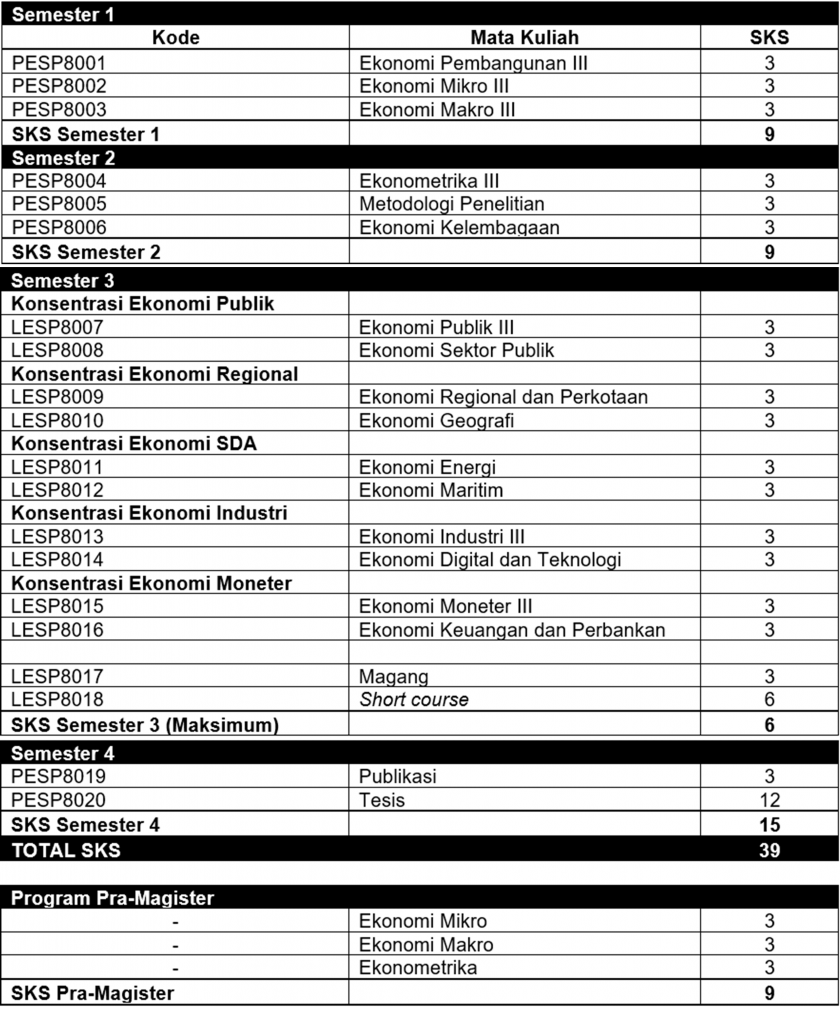
Notes :
A concentration is offered when there are at least 10 students interested in the concentration or when it represents the highest percentage of student interest.
A maximum of 6 Semester Credit Units may be taken in the third semester. Students may choose to complete one concentration, take one concentration course alongside an internship, or participate fully in a short course.
Elective courses may be taken across higher education institutions as an implementation of the Merdeka Belajar Kampus Merdeka policy.
Further provisions regarding cross-institutional courses, internships, and short courses will be regulated separately.
Students in the Master of Economics by Course program are required to publish a scientific article in a national journal indexed in Sinta 4 or higher. This requirement must be demonstrated by a Letter of Acceptance (LoA).
The Pre-Master Program is conducted two weeks before the commencement of lectures, with the number of sessions adjusted as necessary.
Master of Economics Program by Research :
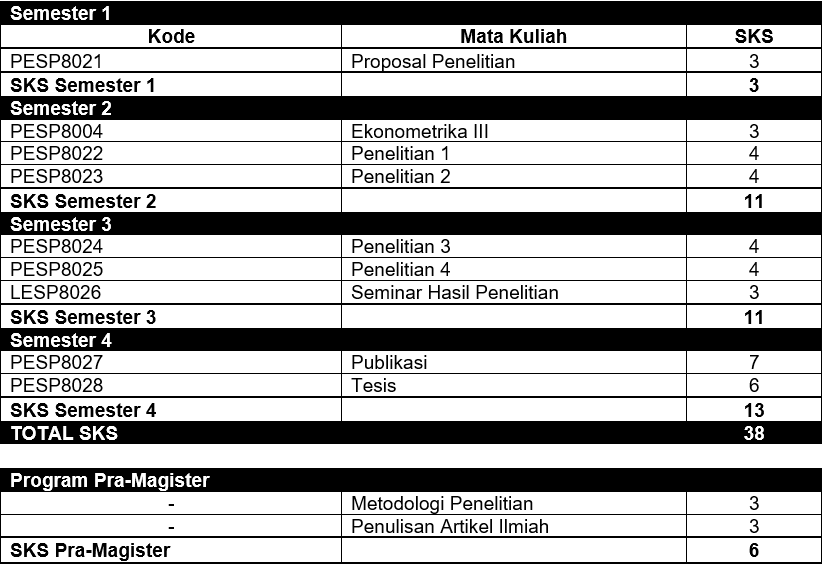
Notes :
Students enrolled in the Master of Economics by Research program are required to take Econometrics in the second semester.
The Pre-Master Program is conducted two weeks before the commencement of lectures, with the number of sessions adjusted as necessary.
Students in the Master of Economics by Research program are required to publish a scientific article in a reputable international journal. This requirement must be demonstrated by a Letter of Acceptance (LoA).
2024 Curriculum
Based on Minister of Education, Culture, Research, and Technology Regulation No. 53 of 2023 concerning Quality Assurance in Higher Education, the Master of Economics Study Program implemented a Competency-Based Curriculum (CBC), also known as Outcome-Based Education (OBE), beginning in the Odd Semester of the 2024/2025 Academic Year, effective July 1, 2024.
The curriculum consists of two programs, namely the Master of Economics by Course and the Master of Economics by Research, with each program requiring 54 Semester Credit Units. The curriculum was developed to respond to developments in the academic field, particularly in Economics. It establishes a clear relationship between courses and Graduate Learning Outcomes, which is presented through a comprehensive curriculum map. All Graduate Learning Outcomes are addressed through the Course Learning Outcomes, and each Course Learning Outcome contributes to the achievement of the Graduate Learning Outcomes. The curriculum ultimately emphasizes graduate competencies and the impact that graduates are expected to generate.
The 2024 Curriculum consists of two study options, namely the Master of Economics by Course and the Master of Economics by Research.
Master of Economics Program by Course :
Under the Competency-Based Curriculum, the Master of Economics by Course program requires a total of 54 Semester Credit Units. These consist of 45 Semester Credit Units of compulsory courses and 9 Semester Credit Units of concentration courses.
The compulsory courses consist of 21 Semester Credit Units of structured courses, 6 Semester Credit Units of research courses, 6 Semester Credit Units of publication courses, and 12 Semester Credit Units for the thesis.
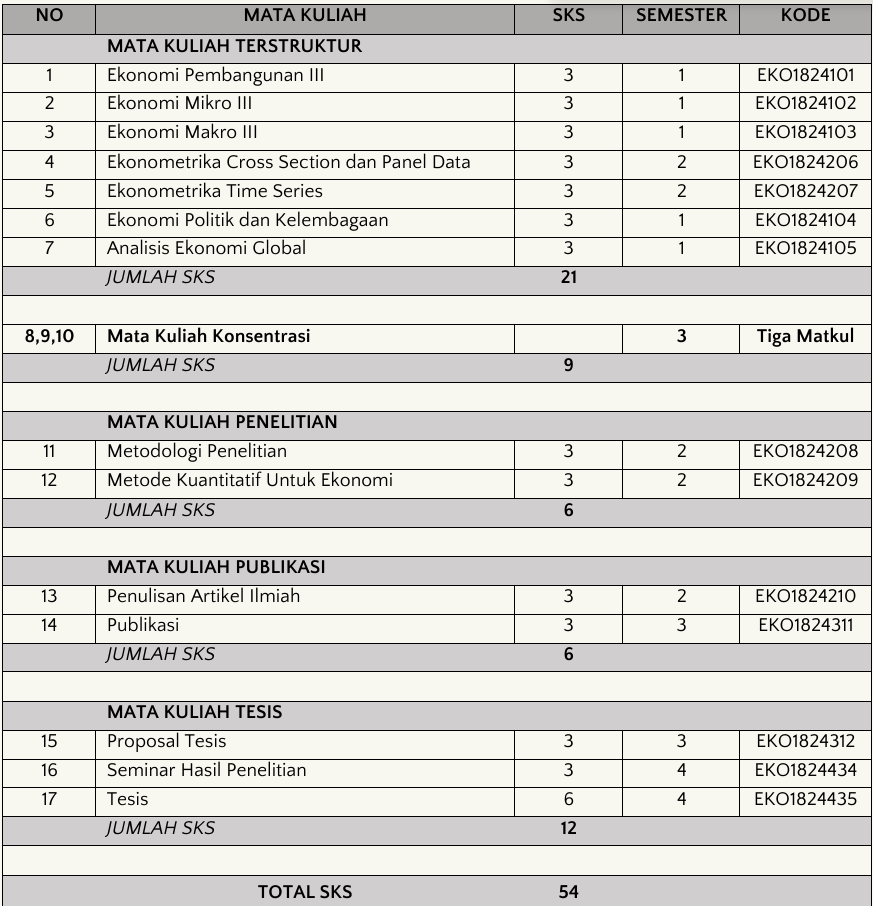
Concentration Courses
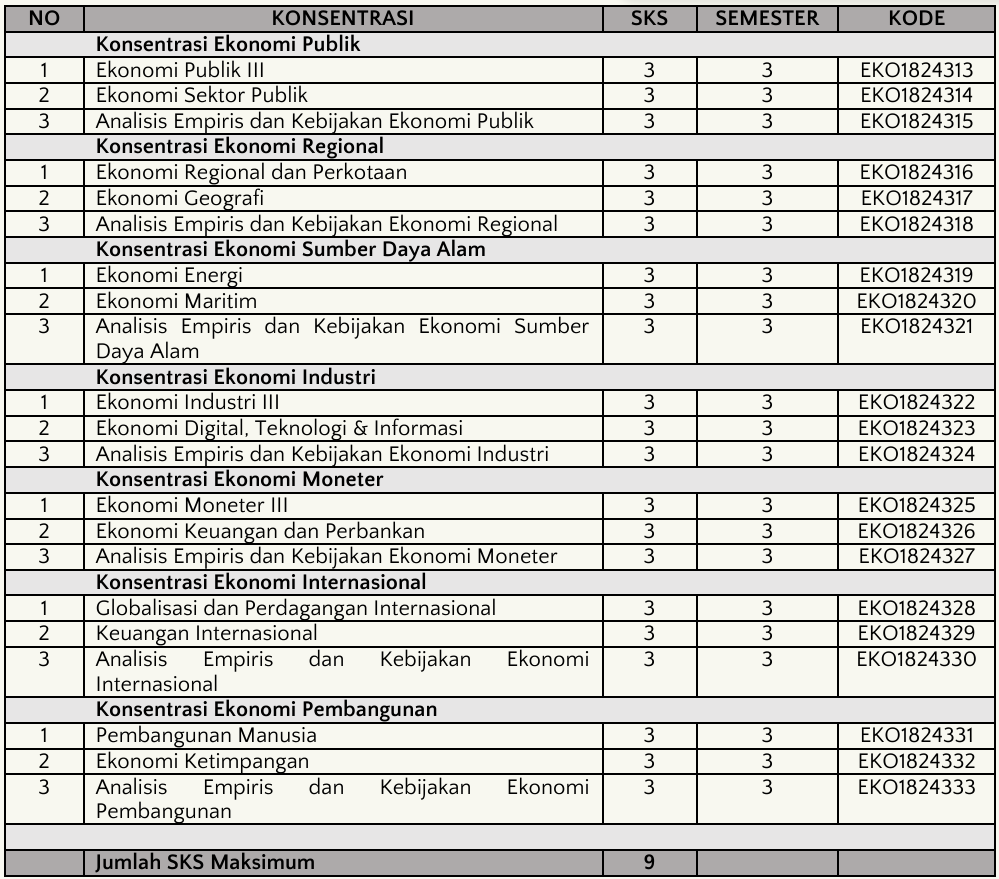
Notes :
The 9 Semester Credit Units of concentration courses are offered based on student interest and subject to the minimum number of students required. If the minimum requirement is not met, the Study Program will determine the concentration to be offered.
The available concentrations are Public Economics, Regional Economics, Natural Resource Economics, Industrial Economics, Monetary Economics, International Economics, and Development Economics.
Thesis supervisors are assigned at the beginning of the second semester, although the curriculum indicates that the Thesis is taken in the fourth semester. Therefore, thesis preparation is conducted in parallel with the coursework, with the aim of enabling students to complete their theses on schedule by the end of the fourth semester.
Master of Economics by Course Program :
The implementation of the Master of Economics by Course program is further described as follows.
A. Compulsory courses are delivered through structured lectures within the Master of Economics Study Program at Universitas Diponegoro, in accordance with the applicable regulations.
B. Concentration courses are offered based on student interest and subject to the minimum number of students required. If the minimum requirement is not met, the Study Program will determine the concentration to be offered.
C. Students are required to publish at least one article in an international journal, a national journal indexed in Sinta 4, or an indexed international conference proceeding.
D. Students enrolled in the Master of Economics by Course program are required to complete the Pre-Master Program, which consists of three courses: Microeconomics, Macroeconomics, and Econometrics, each carrying 3 Semester Credit Units.
Master of Economics by Research Program :
Under the Competency-Based Curriculum, the Master of Economics by Research program requires a total of 54 Semester Credit Units. The program is primarily structured around a research process aimed at producing a Thesis and scientific publications. These components form an integrated process throughout the student’s period of study.
The curriculum consists of Research Course 1 (18 Semester Credit Units), Research Course 2 (12 Semester Credit Units), Publication Course (9 Semester Credit Units), and Thesis (15 Semester Credit Units). These courses constitute an integrated research process from the beginning to the completion of the study program.
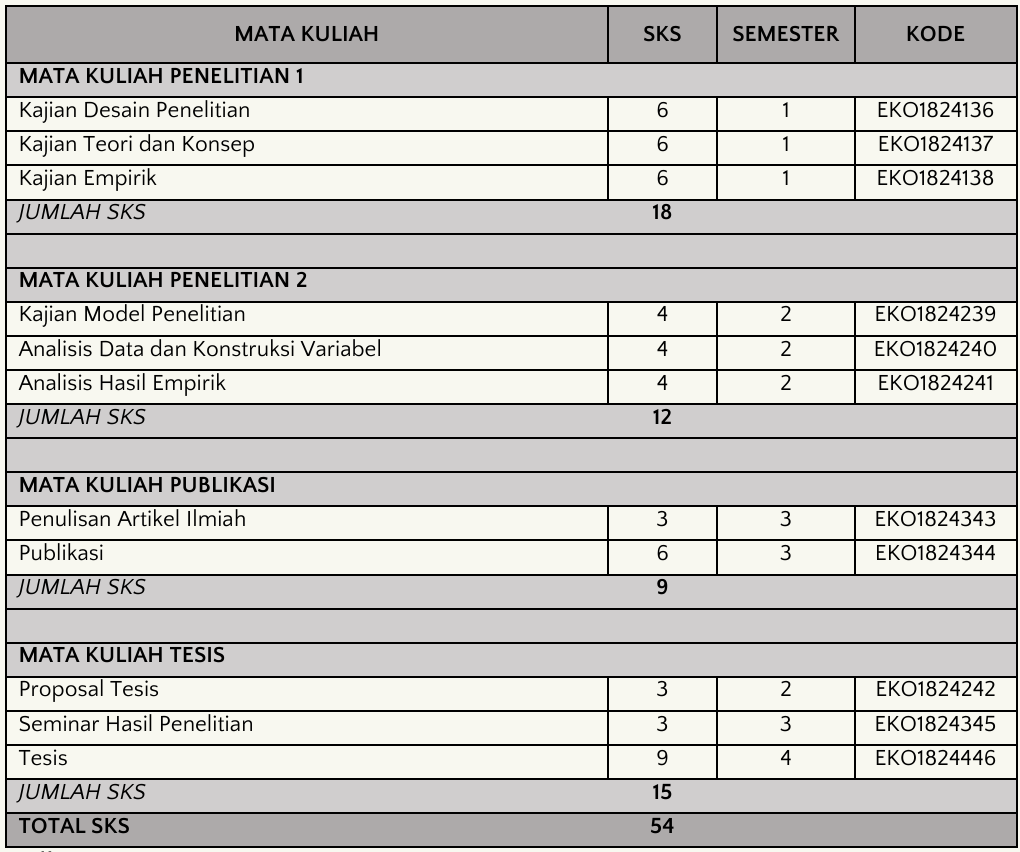
Notes :
Thesis supervisors are assigned at the beginning of the first semester, in accordance with the characteristics of the Master of Economics by Research program, although the curriculum indicates that the Thesis is formally taken in the fourth semester. Accordingly, the thesis preparation process begins from the early stage of the study period, with students expected to complete their Thesis on schedule by the end of the fourth semester.
Students are required to publish at least one article in a reputable international journal indexed in Scopus or Web of Science.
Students enrolled in the Master of Economics by Research program are required to complete the Pre-Master Program, which consists of two courses: Research Methodology and Scientific Article Writing, each carrying 3 Semester Credit Units.
Other Provisions :
A. Students enrolled in special programs, such as PMDSU, FAST TRACK, or collaborative programs, follow the respective program schemes, with specific policies determined according to the conditions and developments in their implementation.
B. Internships, as an activity to develop students’ soft skills, are accommodated and facilitated as part of the learning process and are recorded in the Diploma Supplement (Surat Keterangan Pendamping Ijazah or SKPI), along with other relevant activities. Internships are conducted under the following provision:
Students who intend to undertake an internship are required to prepare a proposal and submit it to the Head of the Study Program prior to the commencement of the internship.
C. Learning assessment is conducted in accordance with the academic regulations applicable at Universitas Diponegoro.