
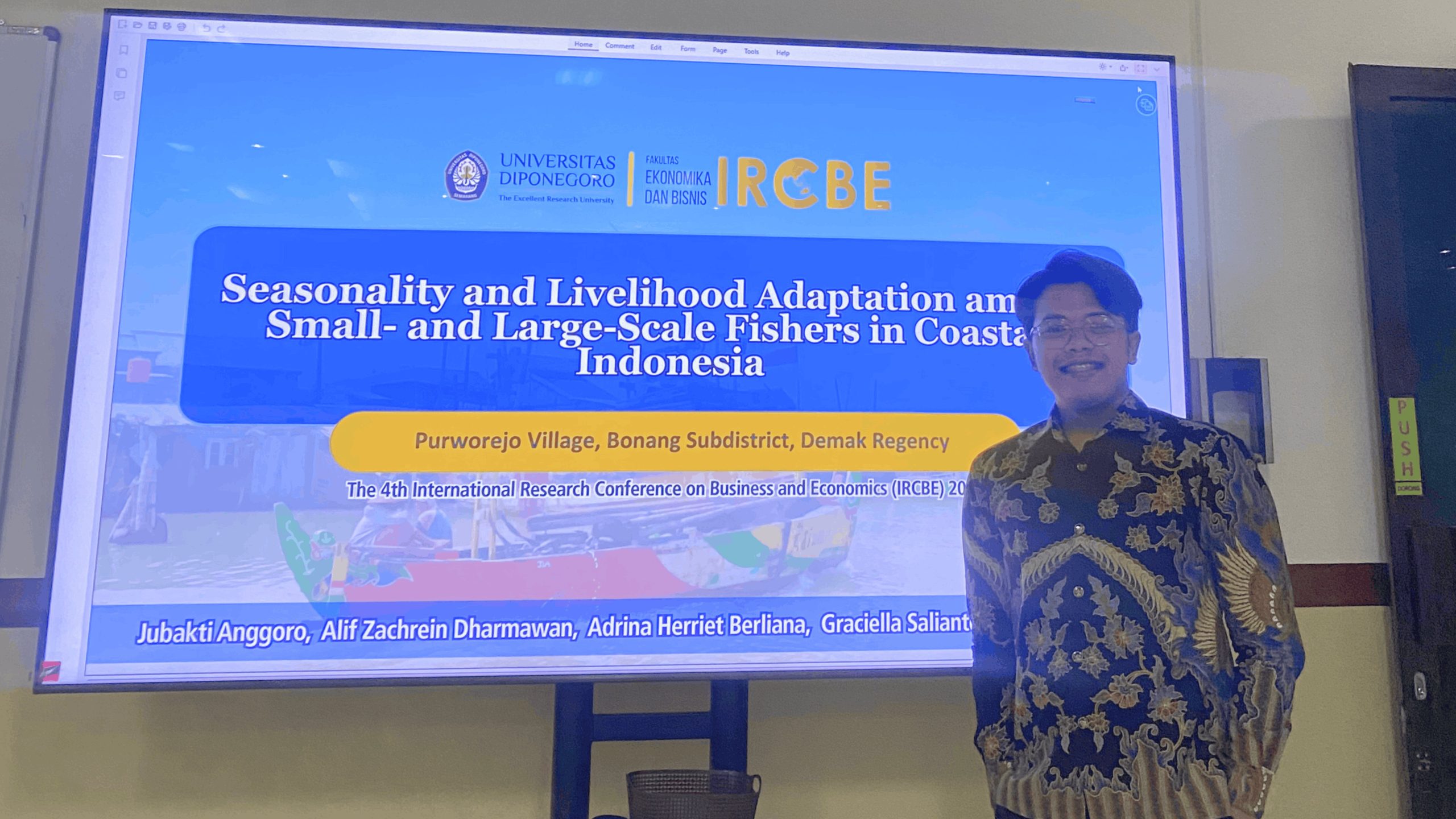
Semarang – Jubakti Anggoro, a student in the Master’s Program in Economics at the Faculty of Economics and Business (FEB), Universitas Diponegoro, presented his research findings on the livelihood adaptation of fishers along the coast of Demak Regency at The 4th International Research Conference on Business and Economics (IRCBE) 2026.
IRCBE is an international academic conference organized by FEB Undip. Its fourth edition took place on October 14–15, 2026, in a hybrid format—held in person at the KWU Building of FEB Undip, Semarang, and virtually via an online platform. This year, the conference centered on the theme “Business and Economic Strategies for a Sustainable Future: Balancing Growth and Environmental Responsibility,” addressing the global challenge of aligning economic growth with environmental stewardship.
During the conference, Jubakti presented his research titled “Seasonality and Livelihood Adaptation among Small- and Large-Scale Fishers in Coastal Indonesia.” Conducted in Purworejo Village, the study examines how fluctuations in fishing seasons affect the livelihoods of fishers, as well as the adaptation strategies they employ to survive during lean seasons.
The research compares small-scale and large-scale fishers. Differences in capital, fishing fleets, and market access lead these two groups to respond to seasonal changes in distinct ways—such as through income diversification, adjustments to fishing patterns, and the utilization of social networks or credit. A deeper understanding of these differences is intended to inform the development of more targeted protection programs for fishers.
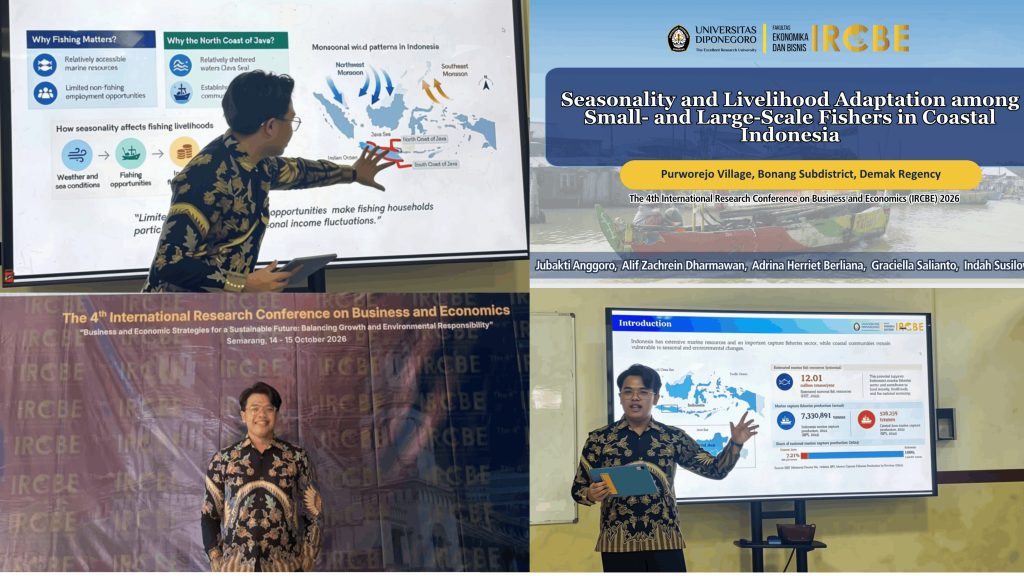
Jubakti noted that, for him, research at the master’s level serves a purpose beyond merely fulfilling academic requirements. “As a master’s student, I view research not merely as an effort to answer a research question, but also as a way to gain a more holistic understanding of societal conditions—and, to the extent possible, to contribute to their improvement. Fisherfolk in Purworejo face seasonal uncertainties every year, and the strategies they employ offer significant insight into the economic resilience of coastal communities,” he stated.
He added, “Through this international forum, I aim to bring findings from the local level into the global discourse on sustainable development, ensuring that the experiences of small-scale fishers are considered in policy formulation. This forum also serves as an opportunity to gain input from researchers across various countries and to expand my academic network.”
Previously, during his undergraduate studies at the Faculty of Economics and Business, Universitas Diponegoro (FEB Undip), Jubakti presented research on plastic waste management in the Karimunjawa marine conservation area at the international conference MARLISPACE 2026 in Nha Trang, Vietnam. The research presented at IRCBE 2026 continues his interest in coastal economics and the ‘blue economy,’ with a specific focus on the livelihoods of local communities.
Beyond his role as a student, Jubakti is also actively involved as a research assistant and assistant to professors, contributing to various research initiatives centered on sustainability and the blue economy. His participation in these research teams reflects his commitment—as a member of the younger generation—to environmental sustainability and the well-being of coastal communities.
This participation was made possible through the support of Universitas Diponegoro—specifically FEB Undip, under the leadership of its Dean, Prof. Faisal, S.E., M.Si., Ph.D.—as well as the academic guidance of Prof. Dra. Indah Susilowati, M.Sc., Ph.D.
It is hoped that this participation will strengthen FEB Undip’s contribution to the development of research on coastal economics and sustainable development, while simultaneously encouraging postgraduate students to actively disseminate their research findings within international scholarly forums.